How Google’s AI Overview Is Rewriting the Rules of SEO
TL;DR
- Google’s AI Overview is a generative summary that appears at the top of some search results. Instead of compiling a list of links, it provides an instant, synthesized answer drawn from multiple sources.
- Features like AI Overview are reshaping search—driving the evolution of search engine optimization (SEO), generative engine optimization (GEO), and answer engine optimization (AEO).
- GEO is the broader practice of tailoring your content so that AI models can easily find, trust, understand, and quote it in longer-form results such as AI Overviews and AI-powered chats.
- Answer engines are generative AI systems that deliver summarized, concise answers to search queries (versus the list of relevant links that used to appear on a Google results page).
- AEO is the practice of tailoring your content to get AI tools (from AI Overviews to AI chatbots) to “select” your content as a direct answer for search queries. While this has some overlap with GEO, there are subtle, important differences.
There’s no denying that generative AI is completely redefining and reshaping the web as we know it. With features like Google’s AI Overview, we’re experiencing a shift in the way people search, discover, and engage with information. Instead of serving up a list of links, search engines are starting to “talk” in full answers—right at the top of the results page.
For marketers and SEO strategists, this shift changes the rules of the game. It’s no longer simply a race to the top 3 search spots on Google; it’s about becoming a trusted source that AI cites in its curated answers. While traditional SEO tactics still hold weight, they’re no longer enough.
As the AI era unfolds, let’s take a look at how features like AI Overview are transforming search and unveiling new ecosystems and marketing tactics—like generative engine optimization (GEO) and answer engine optimization (AEO).
What Is AI Overview?
Google’s AI Overview offers a personalized generative summary that appears at the top of some search results. Instead of compiling a list of links like we’re used to, it provides an instant, synthesized answer pulled from multiple sources (which usually display as citations with links alongside the answer). Like traditional search results, the same query could produce varied AI Overviews based on the user’s location, search history, and more.
In Google’s words, “AI Overviews help people get to the gist of a complicated topic or question more quickly, and provide a jumping off point to explore links to learn more.” Here’s an example of what an AI Overview might look like.
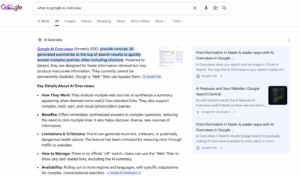
What is Generative AI?
The word “generative” is used to describe AI systems that produce new content (aka the summarized answer that shows up in the AI Overview) rather than simply analyzing. Generative AI models are trained using large datasets, drawing knowledge from the data to understand topics and present them in a conversational way.
At this point, you’ve probably heard of Gemini, Google’s generative AI technology. Gemini is actually a family of AI models that power the Gemini Chatbot, AI Overviews, AI Mode, AI features and assistants on Android phones, and many other products and services.
To give you an idea of Gemini’s growing reach, Apple announced that Gemini (alongside other Google cloud technologies) will power new upgrades to Apple’s virtual assistant, Siri, and other future Apple offerings.
How Do Google AI Overviews Work?
Much like the Google algorithm for search, the ins and outs of AI Overviews are complex and proprietary. That being said, here are some high-level answers to foundational questions about this new technology.
- Who: Google launched AI Overview in the U.S. in May 2024. Since then, AI Overviews have launched in over 200 countries and in more than 40 languages.
- What: AI Overview delivers a concise, AI-generated answer (in paragraph or bullet form) with links to the sources it pulled from.
- Where: AI Overview appears at the top of the search engine results page (SERP) with visual differences from the standard Google SERP, which returns a list of links.
- When: While AI Overviews can show up for many different search queries, they most commonly pop up when Google detects a question—often a “how” or “why” query. (Spoiler alert: this opens the door for lots of content optimization opportunities surrounding niche question queries and long-tail keywords.)
- Why: AI Overview aims to make your search experience more efficient by providing you with a well-rounded set of information and sources on your searched topic.
- How: Each AI Overview is powered by Gemini, so it can pull, summarize, and restructure information in a digestible way (instead of just extracting and displaying snippets). AI Overviews can use techniques like “query fan-out” to search across related subtopics and sources to gather additional information on your query to give you a more comprehensive, nuanced overview (often with opportunities to explore related topics as well).
As a result, some searchers are now getting the answers they need before they ever scroll or click. This is inevitably changing search behavior (leading to trends like zero-click searches) and should also change how you approach your content and SEO/GEO/AEO strategy.
Why It’s a Big Deal for Marketers
Google’s AI Overview is more than just a fancy user interface (UI) feature—it’s an evolution of search as we know it. This means that it has undeniably changed users’ search behavior—and will continue to for months and years to come. Consequently, you’ll have to adapt your organic and paid search strategies pronto (if you haven’t already). Otherwise, you may find yourself falling behind competitors who are quickly adapting.
AI Overview (alongside it’s more in-depth AI Mode, which deserves its own article) spotlights Google’s evolution from a traditional search engine into an answer engine in this exciting AI era.
What Are Answer Engines?
Answer engines are generative systems designed to deliver direct answers to search queries. They’re the AI-powered tools driving the shift from SEO to generative engine optimization (GEO) and answer engine optimization (AEO).
SEO, GEO and AEO At-a-Glance
| Strategy | Goal | Metric |
| SEO | Get a click | Keyword rankings and organic traffic to your site |
| GEO | Be the cited source | AI mentions and citations |
| AEO | Be the answer | Brand awareness and share of voice |

What is Generative Engine Optimization (GEO)?
GEO is the general practice of tailoring your content so that AI tools (like Google’s AI Overview and AI-powered chatbots) can easily find, trust, understand, and include it in their results.
Without getting too nitty gritty, these AI tools use large language models (LLMs) to understand and generate human language and responses, which is why they’re called generative AI. These LLMs are trained using massive datasets that help them learn patterns, relationships and other language nuances, giving generative AI tools the ability to create new content in response to users’ requests. This is important to understand because it gives you insight into how AI might interpret search queries and favor certain content.
What is Answer Engine Optimization (AEO)?
AEO is a little bit different from GEO. While GEO is a broad practice of getting AI to cite your content, AEO is the practice of tailoring your content so that AI tools can find it and use it to directly answer queries. At first, AEO was centered around getting your content to be “selected” for rich, skimmable results in Google, like featured snippets (those little boxes you see at the top of your Google results). AEO continues to evolve past rich results into broader AI ecosystems like ChatGPT, Perplexity, Claude, and today’s topic—Google’s AI Overviews.
While GEO and AEO have subtle, yet important differences, each will continue to evolve and play a role in your well-rounded digital strategy.
What Does This All Mean for the Future of Search?
AI, answer engines, GEO, and AEO won’t stop evolving and reshaping search anytime soon—if ever. That means exciting new developments and lots of learning opportunities are in our collective future. The good news? We’re just as curious as you are, so we’re breaking down these two topics next:
Navigate Digital Disruptions with WebAgency
Whether you need a forward-thinking SEO/GEO/AEO strategy, help with your paid advertising campaigns, or just general guidance and clarity in the AI era, we can help. If you’re ready to align your digital strategy, marketing, and content to the opportunities and demands of today, drop us a line or call us at 603-891-0304.