What Is Zero-Click Search? A Quick Guide for Marketing Leaders
TL;DR
- A zero-click search happens when someone gets their answer directly on a search or answer engine results page—without immediately clicking through to a website.
- Zero-click searches now account for the majority of Google searches in the U.S., and AI Overviews are accelerating the trend.
- For B2B and high-consideration brands, this may mean fewer clicks to your site, but more opportunities to be the answer a potential customer sees.
- Less click volume doesn’t have to mean fewer opportunities—it means new opportunities. The goal is to earn a place in AI-generated answers, and that starts with strong content.
- To win in this environment, shift how you approach your strategy and measure success: from clicks and traffic to visibility, citations, and share of voice.
If your organic traffic has quietly dipped even though your rankings look fine, zero-click search is probably part of the story. This AI-fueled experience is reshaping how people get answers online—and how marketers measure success.
To help you cut through the noise, let’s do a quick dive into what zero-click search is, how much it’s shifting the rules of search, and what it all means for your marketing strategy.
What Is Zero-Click Search, and Why Does It Happen?
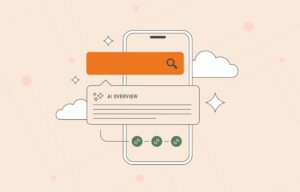
A zero-click search is exactly what it sounds like: someone types a question or phrase into a search engine or AI platform and gets their answer right there on the results page—without immediately clicking through to a website. On Google, for example, this happens through features like:
- Google AI Overview – AI-generated summary that answers the search directly
- Google AI Mode – a conversational experience that lets users ask follow-up questions
- People Also Ask (PAA) – the expandable on-page list that reveals related answers
- Featured snippets – the boxed answer at the top of results
- Knowledge panels – quick-reference cards showing key facts and bios for brands, people, and places
- Direct answer widgets – tools that display live data like currency conversions, weather, or scores
Beyond Google, people are also finding on-page answers within other search platforms like Microsoft Bing and generative AI chat tools like ChatGPT, Claude, Perplexity, Microsoft Copilot, Google Gemini, and more.
These features and platforms may look different, but the effect is the same: people find what they’re looking for and move on.
How Common Are Zero-Click Searches, Really?
When features like Google’s AI Overviews first launched, they mainly appeared for simple questions. Now they’re showing up for a wider range of searches, including high-consideration questions—like the ones your buyers might be asking. And as more answers appear directly in search results, fewer people need to click through to websites right away.
According to Search Engine Land1:
- U.S. Google searches ended without a click 68% of the time in early 2026, up from about 60% in 2024.
- AI Overviews appeared on more than 20% of Google searches, and when they did, click-through rates to websites dropped by nearly 60%.
The numbers above are just one snapshot of a much bigger shift—from clicking to skimming and chatting back and forth with AI.
| Search Era | User Behavior | Marketing Focus |
| Traditional Search | People search, compare results, and visit websites. | Rank well and earn the click. |
| Zero-Click Search | People find answers directly on the search results page. | Earn featured snippets, AI Overviews, and other features. |
| AI Conversational Search | People ask AI follow-up questions and receive synthesized answers. | Create authoritative content that AI tools trust and cite. |
Why This Matters for Growth-Focused Marketing Teams
For marketing leaders, zero-click search changes two things at once: how buyers find your products or services, and how you measure the impact of your marketing.
- Your funnel starts higher and quieter. Prospects may form an opinion of your category and brand before ever landing on your site. If you’re not part of that AI-generated answer, a competitor probably is.
- Clicks and sessions aren’t the whole story anymore. Leadership and finance still want proof of ROI, but traffic alone increasingly undercounts marketing’s actual influence on the buyer’s journey.
- Trust and authority carry even more weight. Answer engines favor content that’s clear, well-structured, and genuinely credible. The good news is that this shift rewards teams willing to invest in real expertise, not just volume.
How to Adapt Your Digital Strategy in the Zero-Click Era
Adapting doesn’t mean starting over; it means shifting your focus in a few key ways:
- Structure content to be “answer-ready.” Use clear headings (phrased as questions where it makes sense), provide concise direct answers, and use bulleted lists that are easy for both humans and AI tools to scan.
- Track new success metrics. Alongside clicks, start watching brand mentions, AI citations, and branded search volume—signals that you’re winning visibility even when a site visit doesn’t happen during that session.
- Double down on original expertise. Answer engines are more likely to cite content backed by real data, first-hand experience, or a distinct point of view—not recycled explainers.
- Don’t abandon SEO best practices—expand them. SEO fundamentals (site health, authority, relevance) still underscore whether AI tools trust your content enough to cite it.
The rules of search might be changing, but one thing remains the same—great content still wins. If you’re looking for a deeper playbook to help keep your website visible, check out our post on optimization dos and don’ts in the AI search age.
Navigate Digital Disruptions with WebAgency
Whether you need a forward-thinking SEO/GEO/AEO strategy, help with your paid advertising campaigns, or just general guidance and clarity in the AI era, we can help. If you’re ready to align your digital strategy, marketing, and content to the opportunities and demands of today, drop us a line or call us at 603-891-0304.
- Danny Goodwin, “Google zero-click searches hit 68% in early 2026: Study,” Search Engine Land, June 9, 2026, https://searchengineland.com/google-zero-click-searches-2026-study-479717